The City God Spared, Then Didn't
Fresh archaeological evidence of Nineveh's fall in 612 BC, and what the same city's earlier, non-covenantal rescue under Jonah still teaches about mercy, Israel's promises, and the gospel today.
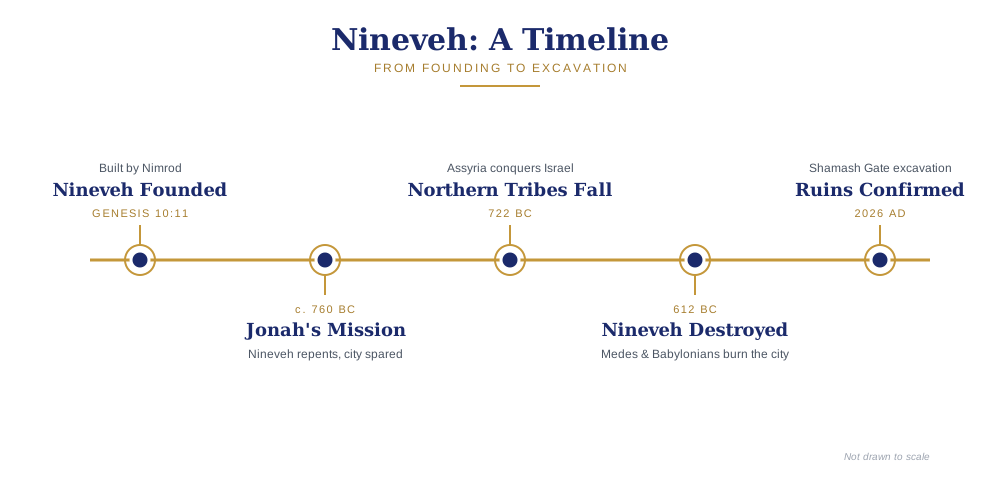
Archaeologists working at Nineveh’s Shamash Gate, outside Mosul in northern Iraq, just published three years of excavation results in the journal Iraq. They found what you’d expect from a city that fell in a single violent night: bronze and iron arrowheads, a burned layer of ash and charcoal, several sets of human remains, and 196 fragments of a shattered limestone stele honoring King Ashurbanipal. The team dates the destruction layer to 612 BC, the year a coalition of Medes and Babylonians ended the Assyrian Empire by burning its capital to the ground.
If you don’t know, Nineveh has played a key role in the progression of God’s plan and communication to man in multiple ways, likely more than people realize. Nineveh was the capital of Assyria–the nation that God chose to enact His judgement on Israel for Israel’s covenant-breaking behavior. They were the ones that destroyed and captured the Northern 10 tribes of Israel in 722 BC (2 Kings 17:5-6). The Northern tribes have been lost ever since.
Most famously, people know it from the book of Jonah, where a prophet of Israel was sent to this gentile nation to warn them of God’s intent to destroy their city because of their own wickedness and preach a message of repentance. This happened roughly forty years before Assyria was sent to destroy Israel.
Understanding why God ever showed that city mercy in the first place means backing up much further than Jonah’s lifetime.
God has always been in the business of reconciling what sin broke. Not just people. Heaven and earth both got corrupted by the fall, and both are on God’s list to eventually restore (Colossians 1:20). Somewhere inside that plan, God pulled one man out of Ur, gave him a set of promises, and told him that through his descendants the earth itself would one day be set right. That man was Abram (Genesis 12:1-3). That nation was Israel.
Every covenant that follows in the Old Testament belongs to that one family line, Abraham, then Isaac, then Jacob. Land. A kingdom. A royal priesthood, a nation of priests meant to bless the whole world (that’s the exact calling God gave Israel at Sinai, Exodus 19:6). An everlasting throne. None of it was ever offered to anyone standing outside that lineage. The rest of the Old Testament is largely the record of God building that nation, Israel failing to hold up its end again and again, and prophet after prophet promising a future day when the failures get overturned and the promises finally land.
Then Jonah happens, and it doesn’t fit the pattern. A prophet from Israel gets sent, not to Israel, but to the capital of the very empire about to march in and finish off the northern kingdom. Read straight through the Old Testament and Jonah looks like it wandered in from a different book.
God gives Nineveh a warning. Forty days, then judgment, unless something changes. Nothing about a covenant. Nothing about a kingdom. Just a deadline and a way out, and Nineveh took it. The king put on sackcloth, the whole city fasted and turned from its evil, and Nineveh believed the one message it had just been handed.
“So the Lord repented of the evil, that he had said he would do unto them; and he did it not.” — Jonah 3:10
Notice what Nineveh did not get. No future kingdom or land grant, no promise of becoming a great nation, no everlasting throne. No calling to be a kingdom of priests reconciling the world to God. No law, no covenant. All of that stayed exactly where it already belonged, with Israel. What Nineveh got was a single line: believe this one message, about judgment and mercy, and God will spare you. When they believed it in faith, God did what he promised. He spared them.
I keep coming back to this because God is running a similar shape of program with the church right now, just on a far bigger scale. We’ve been handed our own specific message: Christ died for sin and rose again, and by that finished work alone you’re saved by grace, completely apart from anything you do (Ephesians 2:8-9) AND completely apart from Israel’s covenants (Romans 9:4). Out of believing that, we inherit a promise, the same one Abraham was given before he ever had a law or a nation attached to his name: righteousness credited by faith (Galatians 3:6-9). But like Nineveh, receiving that promise doesn’t hand us Israel’s whole portfolio. We are not the next chapter of Israel’s story. We are something new, a new creature with a hope of our own (2 Corinthians 5:17), and that hope is heavenly. Israel’s earthly restoration, its land and kingdom and throne, is still out ahead of it, waiting on a day that hasn’t come yet (Romans 11:25-29). It’s the difference between being handed a single check made out in your name and being handed the keys to somebody else’s estate. We got the check. Israel still holds the deed. We share a specific inheritance through Christ. We don’t inherit the rest of what belongs to Israel, and we don’t cancel it either.
That’s what makes the ruins under the Shamash Gate worth noticing. The mercy Nineveh received in Jonah’s day was real, but it was never a permanent arrangement, because it was never a covenant to begin with. It bought that generation a reprieve. It didn’t buy the city an exemption from what came next. A century and a half later, a different Nineveh stopped believing, Nahum’s forecast came due (Nahum 1:1), and now there’s nothing but ruins and remnants of a destroyed nation.

I'm CJ, the founder and pastor of Dispensation of Grace Fellowship. I hope these articles encourage you to study the Bible more and more, as that is the only real source of truth. If you're in the area we'd love to meet you in person this Sunday at 9:30.
What We Believe →Share this post
Comments (0)
Leave a Comment
Thank you! Your comment has been submitted and will appear after a quick review.
Something went wrong. Please try again in a moment.